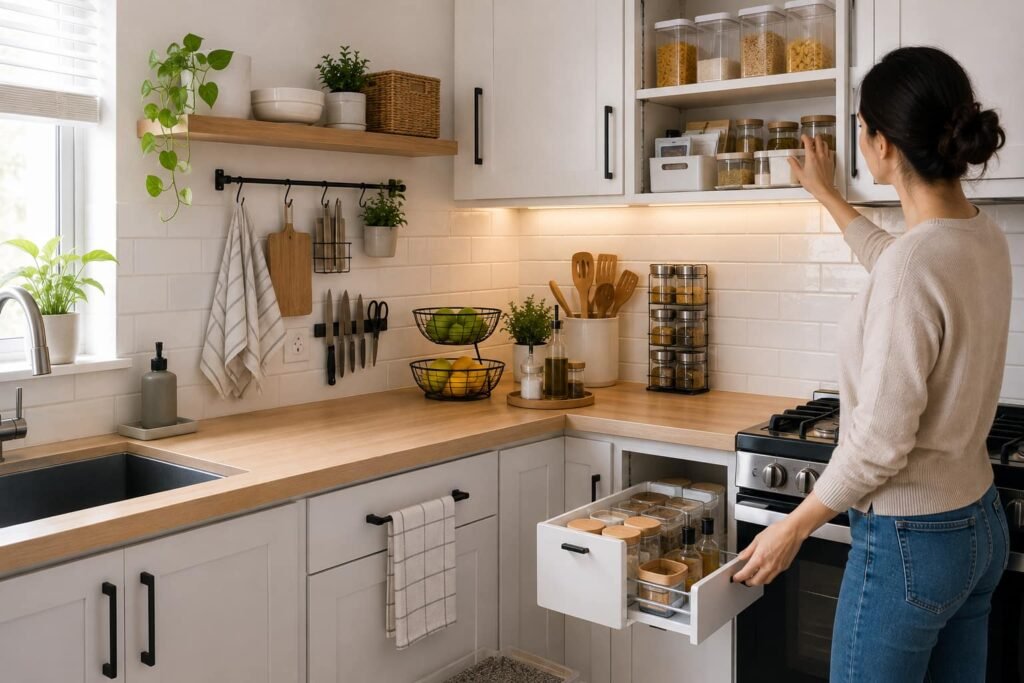
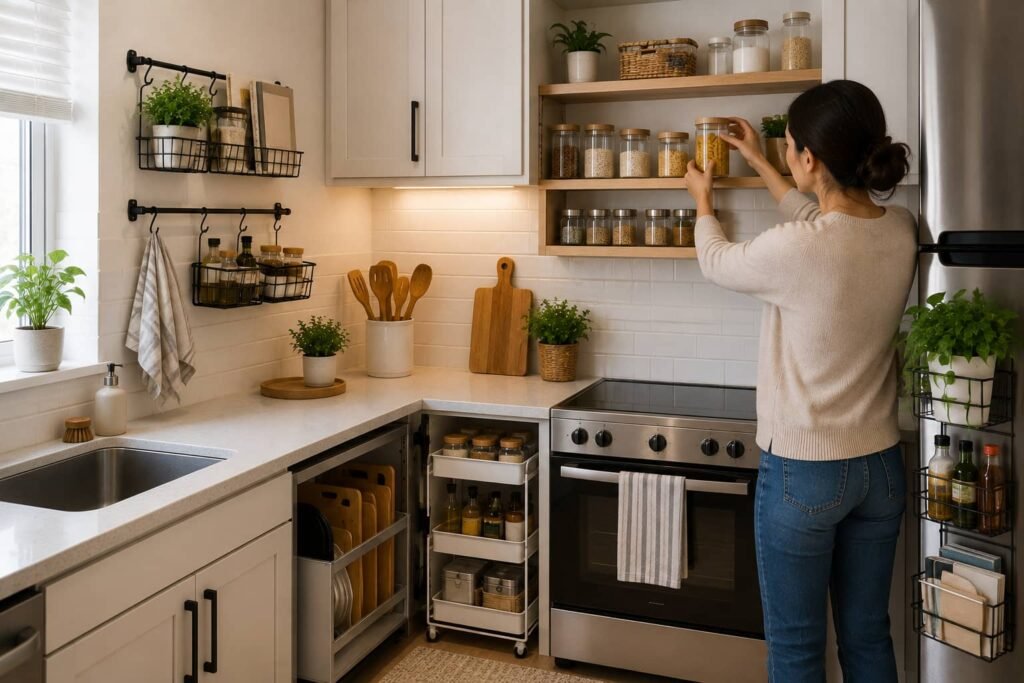
The golden rule for renter-friendly kitchen storage products is simple: if it needs a drill or a permanent screw, skip it. Pick storage that is no-damage, removable, and something you can take with you when the lease ends. In practice that means a handful of product families: tension rods, adhesive hooks and organizers, over-the-door racks, freestanding shelving and rolling carts, and stackable bins, plus no-drill rail systems. Between them they solve almost every kitchen storage problem without touching a wall. Below is each category, what it actually fixes, and the one caveat that keeps your deposit safe.
I want to be honest about how I use this list. I don't lab-test products for 30 days. These are the categories I'd shop myself, chosen from product specs, reviews, and how renting actually works, so you can match the right type to your kitchen instead of buying blind.
The one filter I apply to everything
Before a product earns a spot in a rental, it has to pass three questions:
- Does it need a drill or a permanent screw? If yes, it's out.
- Can I remove it cleanly? No paint pulled, no glue residue, no holes.
- Can I take it with me? A good renter product moves to the next apartment with you, so it's an investment, not a loss.
Everything below passes that filter. If a product only passes when installed "correctly," I'll tell you exactly what correctly means, because that's usually where deposits get lost.
Tension rods: the quiet workhorse
A tension rod holds itself in place with spring pressure, no hardware at all. In a kitchen it does more than hang a curtain. Stand one vertically inside a cabinet to file baking sheets, cutting boards, and pan lids on edge. Run two across a lower cabinet and you've made a shelf for spray bottles under the sink. Mount one across a narrow gap and hang S-hooks for mugs or utensils.
What it solves: awkward vertical gaps, cabinet dead space, and cleaning-bottle clutter under the sink.
The renter caveat: tension rods have a real weight limit, and they hold by friction, so a rod that's overloaded or set on a slick surface can slip and drop everything. Size the rod to the span (a rod stretched near its maximum tension holds less), and keep heavy items low. Pressure alone leaves no mark, which is exactly why it's a renter favorite.
Adhesive hooks and organizers: convenient, with the biggest catch
Adhesive strips and hooks are the fastest fix on this list. Peel, stick, done. They handle lightweight jobs beautifully: a hook for oven mitts, a caddy for sponges by the sink, small racks inside a cabinet door. The well-known removable strip brands are specifically engineered for clean removal when used within their rated weight, and each strip or hook prints a weight limit on the pack for a reason.
What it solves: small, out-of-the-way storage on the inside of cabinet doors, backsplashes, and appliance sides.
The renter caveat: this is where deposits die. Adhesive removes cleanly only under three conditions. First, respect the weight rating. A strip rated for a light frame will not hold a cast-iron pan, and when it fails it tends to take paint with it. Second, the surface matters. Adhesive grips smooth, sealed, well-bonded paint or tile. On old, flaking, or cheap flat paint, the paint itself is the weak layer, so removal peels the paint, not the glue. Third, removal technique matters: pull the tab straight down along the wall so the strip stretches and releases, never yank it outward. Get any of those wrong and a small hook can cost you more than a nail hole would have.
Because of that catch, I treat heavy adhesive on questionable walls as a no. Save adhesive for light loads and smooth surfaces, and lean on tension and freestanding products for anything with weight.
Over-the-door racks: storage with zero installation
An over-the-door organizer simply hooks over the top edge of a door or cabinet and hangs there. No screws, no adhesive, no marks. On a pantry or closet door it holds spices, foil and wrap boxes, cleaning sprays, or cutting boards. Slim versions fit over a cabinet door under the sink.
What it solves: finding a whole vertical surface you forgot you had, without touching it permanently. This pairs well with a no-pantry kitchen, where door backs become your pantry.
The renter caveat: the metal hooks can rub or dent the top edge of a hollow or softwood door over time, and a door-mounted rack can stop the door from closing flush or bump the frame. Choose a rack with foam or rubber-padded hooks, don't overload it, and check that the door still shuts cleanly. Felt pads on the hooks are a cheap insurance policy for the door's finish.
Freestanding shelving and rolling carts: the deposit-proof heavy lifters
If a product stands on the floor, it can hold real weight without any wall risk at all, which makes freestanding pieces the safest category here. A narrow rolling cart becomes a mobile island for produce, small appliances, or overflow pantry items, and it rolls out of the way or into the next apartment with you. A leaning ladder shelf gives you vertical display without a single hole. A slim shelving unit fills the gap beside the fridge.
What it solves: counter overflow, missing pantry space, and the desire for vertical storage when walls are off-limits.
The renter caveat: almost none, which is why I reach here first for anything heavy. The only real limits are floor space and, for taller units, tip stability. In a home with kids or in an earthquake-prone area you may still want a freestanding shelf steadied, but understand that anti-tip anchoring means hardware in the wall, so for a pure no-damage setup keep tall units loaded bottom-heavy and away from high-traffic bumps instead.
Stackable bins and shelf risers: doubling the space you already have
The cheapest win in a rental kitchen is using the vertical air inside your existing cabinets. Stackable bins, clear canisters, and shelf risers turn one tall, half-empty shelf into two usable levels. Pull-out bins on a lower shelf make the back reachable. Nothing attaches to anything, so there's nothing to remove.
What it solves: wasted headroom inside cabinets and pantries, and the "everything is buried behind everything" problem.
The renter caveat: essentially none, since these sit loose on a shelf. Just measure your shelf height and depth before buying so risers and bins actually fit, and favor a stackable system you can add to later rather than a set that only nests one way.
No-drill rail and magnetic systems: the extras worth knowing
A few product types bridge the gap between "hangs on the wall" and "damages the wall." Slide-on under-shelf baskets clamp onto an existing shelf to hang mugs or store wrap, then slide off when you move. If your refrigerator has metal sides, magnetic organizers turn that blank slab into a home for spices, knives, or paper towels with no marks at all. Over-the-sink dish racks and roll-up mats add a work surface that lifts right out.
What it solves: clearing the counter using surfaces you already have (shelf undersides, the fridge flank, the sink).
The renter caveat: under-shelf baskets need a shelf of the right thickness to grip, and magnetic organizers only work on magnetic stainless (many newer fridge doors aren't magnetic, though the sides often are, so test with a magnet before buying).
What NOT to do in a rental (the part most lists skip)
Most roundups only tell you what to buy. Here's what quietly costs renters their deposit:
- Don't install anything screw-mounted. Wall-mounted rails, pot racks, and floating shelves that need anchors leave holes and, in soft drywall, craters. However tempting, they're a renovation, not renter storage.
- Don't put heavy adhesive on cheap or old paint. Flat builder-grade and aging paint isn't bonded well enough to survive removal. The glue wins; the paint loses.
- Don't exceed a product's rated weight "just this once." An overloaded strip or tension rod doesn't fail politely. It fails all at once, often with damage.
- Don't skip the hidden-spot test. Before you commit an adhesive product to a visible wall, stick one strip somewhere hidden (inside a cabinet, behind the fridge) and remove it a day later. If it lifts the paint there, it will lift it everywhere, and you just saved your deposit for the price of one strip.
- Don't assume the door can take it. Over-the-door racks are great until a heavy one warps a hollow door. Pad the hooks and keep the load sensible.
How to remove everything cleanly when you move
Deposit-safety is a two-part job: buy removable, then remove correctly. Take adhesive strips off by pulling the tab straight down along the wall so the strip stretches and lets go, which can take pulling it a good foot or more before it releases. Warming a stubborn strip gently with a hair dryer softens the glue. Lift tension rods and over-the-door racks straight off. Wipe any faint residue with a little rubbing alcohol. Because every product here is freestanding or pressure-mounted, "moving out" mostly means packing, not patching.
Keep organizing your small kitchen
Renter-friendly products are one layer of a bigger system. For the full framework, start with my guide to small kitchen organization ideas, which ties these categories to specific layouts. If your kitchen has no pantry at all, how to organize a small kitchen with no pantry shows where these products go. And for the empty zone above your counters, under-cabinet storage ideas covers the no-drill options for that specific space.
FAQ
What kitchen storage is safe for renters?
Anything that holds by pressure, hangs over a door, stands on the floor, or sits loose inside a cabinet: tension rods, over-the-door racks, freestanding shelving and rolling carts, and stackable bins. These leave no holes and come with you when you move.
Do adhesive hooks damage rental walls?
They can, if you exceed the weight rating, use them on old or cheap paint, or pull them off wrong. Used within their limit on smooth, well-bonded paint and removed by stretching the strip straight down, quality adhesive products are designed to come off cleanly. Test one in a hidden spot first.
How do I add kitchen storage without drilling?
Stack the space you already own with bins and shelf risers, add tension rods inside cabinets, hang over-the-door racks, and bring in a rolling cart or leaning shelf for anything heavy. None of it requires a single hole.
Will a tension rod hold weight in a kitchen?
Yes, within limits. A tension rod holds by friction, so keep loads moderate, size the rod to the span, and place heavy items low. It's ideal for lids, boards, and light hanging storage, not for a full rack of cast iron.
Can I take these products to my next apartment?
That's the whole point. Every category here is removable and reusable, so a renter-friendly storage kit is a one-time buy that follows you from lease to lease instead of getting left behind.