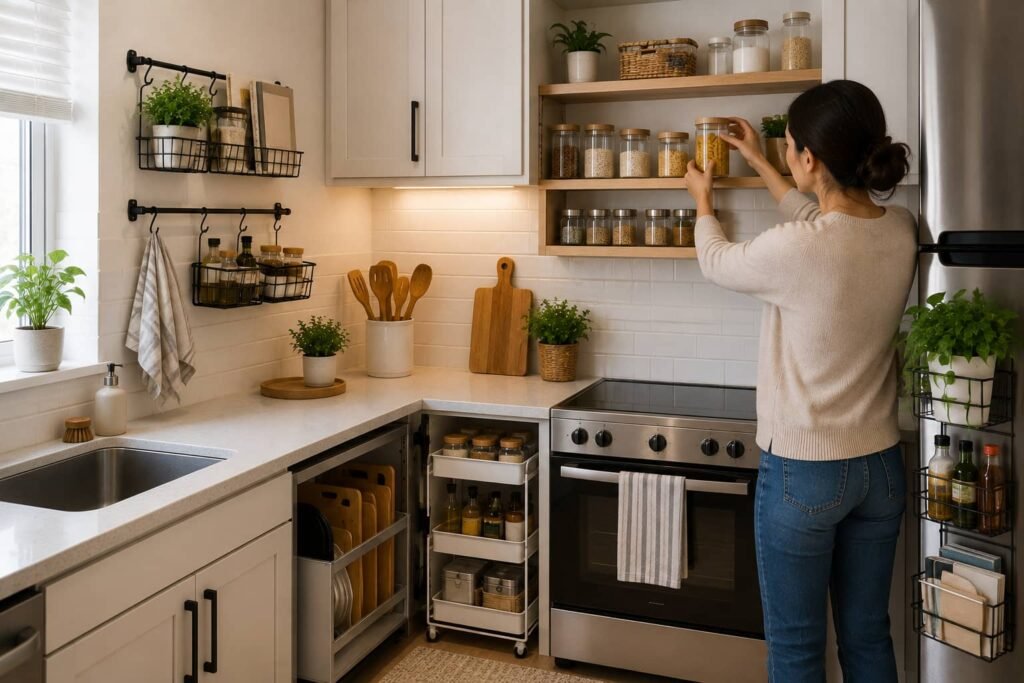
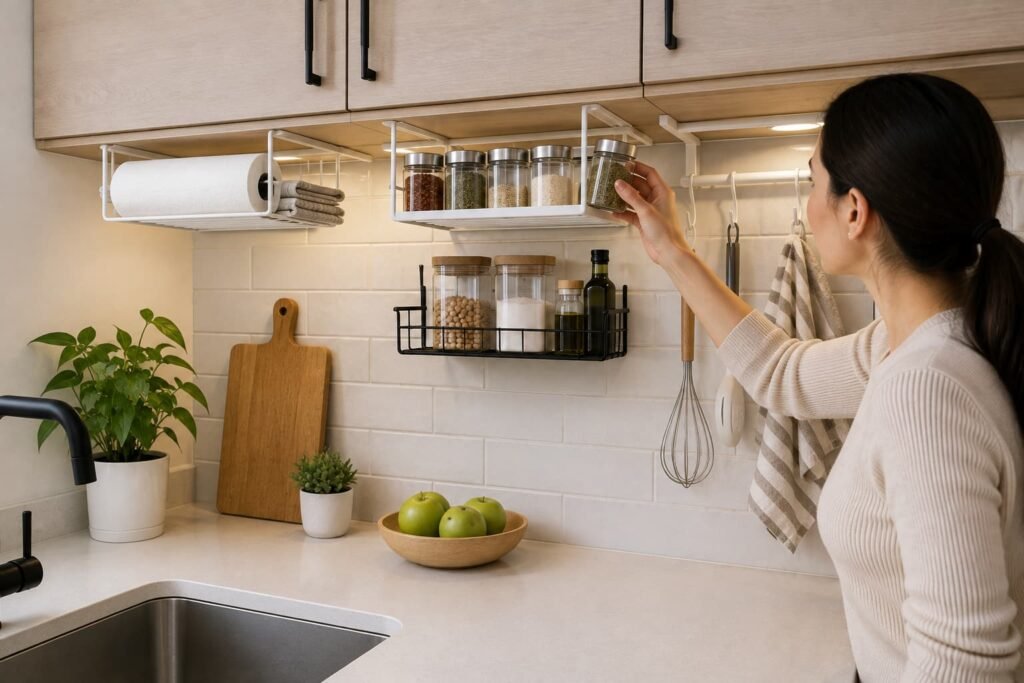
The best small kitchen organization ideas start before you buy anything. Declutter down to what you actually use, then work zone by zone: keep counters mostly clear, use the full height of your cabinets, claim the inside of every cabinet door, and take everything else to your walls. Add store-bought organizers only where one specific item keeps causing trouble, not by the cartload. If you rent, lean on tension rods, adhesive hooks, and freestanding shelves so you can organize without drilling a single hole. That order matters. Most people buy first and declutter never, which is exactly why the kitchen still feels cramped.
I write House Tweaks for people in normal homes and rentals, not showrooms, so this guide is built around your actual constraints instead of a flat list of gadgets. Every idea below gets an honest label: Free (just rearranging), Cheap (a small item most stores carry), or A purchase (a real spend), plus a note when you need tools. You can read more about how I research and pick the ideas I share if you want the background.
First, the honest part nobody selling organizers wants to say
Storage products are not the first answer. They are the last 20 percent.
A small kitchen usually is not short on space. It is holding too much stuff in the space it has. The single highest-impact move is to pull everything out of one zone, be honest about what you have used in the last year, and let the rest go. Duplicate spatulas, the pan you never reach for, expired spices, mugs you do not drink from. That is Free, it takes an afternoon, and it does more than any bin you can buy.
Only after that should you shop, and only for a named problem. "My spices roll around and I can never find cumin" is a named problem worth solving. "I saw a cute organizer set online" is not. Buying a full cart of matching containers before you declutter just means you are now storing clutter in nicer boxes.
And if you rent, your options are genuinely narrower, so let's be real about it. You probably cannot drill into cabinets or tile, you cannot swap out shelving, and you want your deposit back. That rules out a lot of the "just install a pull-out" advice you will see elsewhere. The good news is that no-drill solutions have gotten very good, and I have flagged the renter-safe options throughout.
Counters: keep the working surface clear
Counter space is the thing you feel most in a small kitchen, so protect it. The rule I use: a counter is for working on, not for storing on.
- Move daily-use items off the counter and into a single "grab zone." A small tray or a lazy Susan holds oils, salt, and the three things you reach for while cooking, and lifts everything else off the surface. Cheap, no tools.
- Hang what you can. A rail or a few adhesive hooks under a cabinet gets mugs, measuring cups, or utensils off the counter and onto otherwise dead vertical space. Cheap, and the adhesive versions are renter-safe with no drilling.
- Get the appliance you use once a month out of sight. The bread maker, the blender you touch on weekends, the air fryer box. If it is not earning its counter spot daily, it belongs in a cabinet or on a high shelf. Free.
- Use the space above the counter, not just on it. A tension rod across a shallow gap, or a narrow shelf riser, doubles a run of counter without covering it. Cheap.
If your real headache is counter space rather than cabinet space, that grab-zone move is the one to do this weekend. It buys back the most usable surface for the least effort.
Cabinets: build up, not just out
Most small cabinets waste the air between the shelf and the shelf above it. Reclaim it.
- Add shelf risers or stacking shelves. They turn one tall, half-empty shelf into two usable layers, which is perfect for plates, bowls, or cans. Cheap, no tools.
- Use turntables in the corners and back rows. A lazy Susan for oils, sauces, or spices means you spin instead of digging, and nothing gets lost at the back. Cheap.
- Group by task, not by type. Baking things together, coffee and tea together, everyday plates at the front. Free, and it makes the small space feel twice as organized because you stop hunting.
- Dedicate one cabinet as your "pantry" if you have no pantry. Clear stackable bins by category (grains, snacks, cans) turn a normal cabinet into a working food store. If your whole problem is having nowhere to keep food, that trick deserves its own walkthrough, which I cover in the guide to organizing a small kitchen with no pantry.
The inside of every cabinet door (the most-wasted space)
This is the space almost every flat listicle skips, and it is the best free-ish real estate you own. The inside face of a cabinet door can hold a surprising amount and costs you nothing in counter or shelf space.
- A door-mounted rack holds spices, foil and wrap boxes, or cleaning sprays under the sink.
- Adhesive hooks or a slim caddy on the door hold measuring spoons, pot lids, or a cutting board.
For renters this is ideal because peel-and-stick and over-the-door versions need no drilling. Cheap, and the adhesive options come off cleanly.
Drawers: dividers beat willpower
A small kitchen with two messy drawers feels more chaotic than one with six tidy ones. Drawers reward a little structure.
- Add adjustable dividers or a simple in-drawer tray. Utensils in their lanes, junk drawer sorted into cells. Cheap, no tools, and expandable ones fit odd drawer sizes.
- Store some things on their edge, not flat. Cutting boards, baking sheets, and lids stored upright in a drawer or a slim rack are easier to grab and take less room than a leaning stack. Free to cheap.
- Keep only the tier you actually cook with up front. The specialty gadgets can live deeper or elsewhere. Free.
Walls and vertical space: your biggest untapped zone
When the floor and counters are full, the walls are where a small kitchen finds another room's worth of storage. How far you can go depends on whether you own or rent.
- Magnetic strip for knives, freeing a drawer and your counter block. Mounted versions need screws; there are adhesive-backed options for renters.
- A pegboard or rail system for pots, utensils, and mugs. High capacity, but the mounted kind needs drilling, so owners get the most from this.
- Floating or freestanding shelves for dishes you use daily and want on show. Freestanding shelf units and over-the-door racks give renters real vertical storage with zero holes.
- Over-the-door and side-of-cabinet organizers for wraps, snacks, or produce. Cheap and renter-safe.
If you cannot mount anything at all, freestanding and tension-based systems are the whole game, and I have gathered the specific renter-friendly kitchen storage products worth knowing about so you can skip the trial and error.
Hard-to-use corners and dead zones
Every small kitchen has a spot that fights you: the deep blind corner cabinet, the gap beside the fridge, the space under the upper cabinets.
- Blind corner cabinet: a turntable or a pull-out bin turns a black hole into reachable storage. Cheap to a purchase.
- The skinny gap beside the fridge or stove: a slim rolling cart slides in and rolls out, holding spices, baking sheets, or produce. A purchase, but it converts truly dead space.
- Under the upper cabinets: the shelf-to-counter zone can hold hanging baskets, mug hooks, or a slim shelf for jars. This under-cabinet dead space is worth a closer look on its own, which is why I broke out a full guide to under-cabinet storage ideas.
How to decide where to start this weekend
You do not need to do all of this. Pick the one zone that annoys you most and stop there for now. Here is the fast way to choose.
| Your biggest frustration | Start here | Cost to begin |
|---|---|---|
| Counters always cluttered | Declutter, then build one grab zone | Free |
| Nowhere to put food | Turn one cabinet into a pantry with bins | Cheap |
| Cabinets are a mess | Shelf risers plus turntables | Cheap |
| Drawers are chaos | Adjustable dividers | Cheap |
| Ran out of space entirely | Go vertical: walls or freestanding shelves | Cheap to a purchase |
| You rent and cannot drill | Tension rods, adhesive hooks, over-the-door racks | Cheap |
Do the declutter first no matter which row is yours. It is free, it is the biggest lever, and it tells you what you actually need to buy, if anything.
FAQ
What is the first thing to organize in a small kitchen?
Declutter one zone before buying anything. Pull everything out, keep only what you have used in the past year, and let the rest go. It is free and it does more for a cramped kitchen than any organizer, because the problem is usually too much stuff rather than too little space.
How do I organize a small kitchen without a pantry?
Dedicate one full cabinet as your pantry and sort food into clear, stackable bins by category, such as grains, snacks, and cans. Add over-the-door and inside-the-door storage for wraps and spices to stretch it further.
How can renters organize a kitchen without drilling?
Use tension rods, strong adhesive hooks, over-the-door racks, and freestanding shelf units. These give you vertical and door storage with no holes, so nothing threatens your deposit. Adhesive-backed magnetic strips and peel-and-stick racks cover most of what a drilled setup would.
Do I need to buy a lot of organizers for a small kitchen?
No. Most of the impact comes from decluttering and rearranging, which are free. Buy organizers only to solve a specific, named problem, like spices that roll around, rather than buying a full matching set before you have decluttered.
What is the most wasted space in a small kitchen?
The inside of your cabinet doors and the vertical air above each shelf. Door-mounted racks and shelf risers reclaim both at low cost, and the door options are renter-safe because they need no drilling.