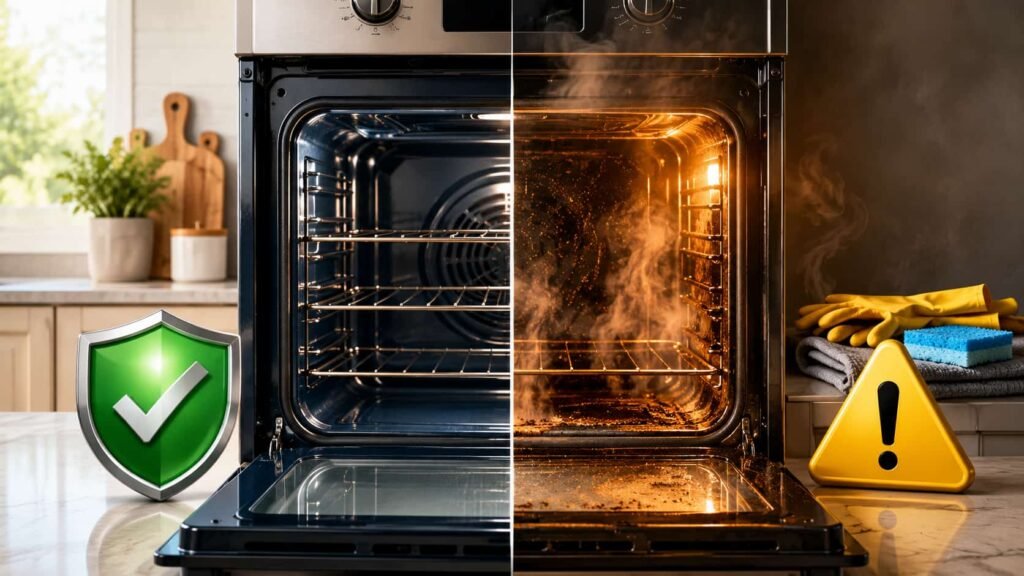
If your kitchen has gone past a quick wipe-down and needs an actual deep clean, the order matters more than the products you use. Degrease the surfaces that shed onto everything else first: the cabinets around the stove, the range hood, the backsplash. Only after that do you move to counters, sinks and appliances, and the floor always comes last. Clean in the wrong order and you are just moving grease from one clean surface onto another, then wondering why the kitchen still feels dirty an hour later.
I write House Tweaks from careful research and product analysis rather than claiming to have professionally cleaned every kitchen type there is, so this guide is about the sequence and the reasoning, not a personality-driven “clean with me” video. You can read more about how I research what I share if you want the background.
Why “just start wiping” makes a greasy kitchen worse
Grease is airborne before it’s visible. Every time you cook, a thin layer settles on the cabinet fronts above the stove, the outside of the range hood, the backsplash, and eventually the tops of anything nearby. It builds slowly enough that most people don’t notice until it’s sticky.
The problem with cleaning counters or mopping the floor before that grease layer is dealt with is simple: a damp cloth or a wet mop picks up airborne grease dust and drags it across whatever you just finished. You end up re-cleaning the same spots, and it feels like the mess is winning. It isn’t. The order was wrong.
The order: grease first, then everything else, top to bottom, floors last
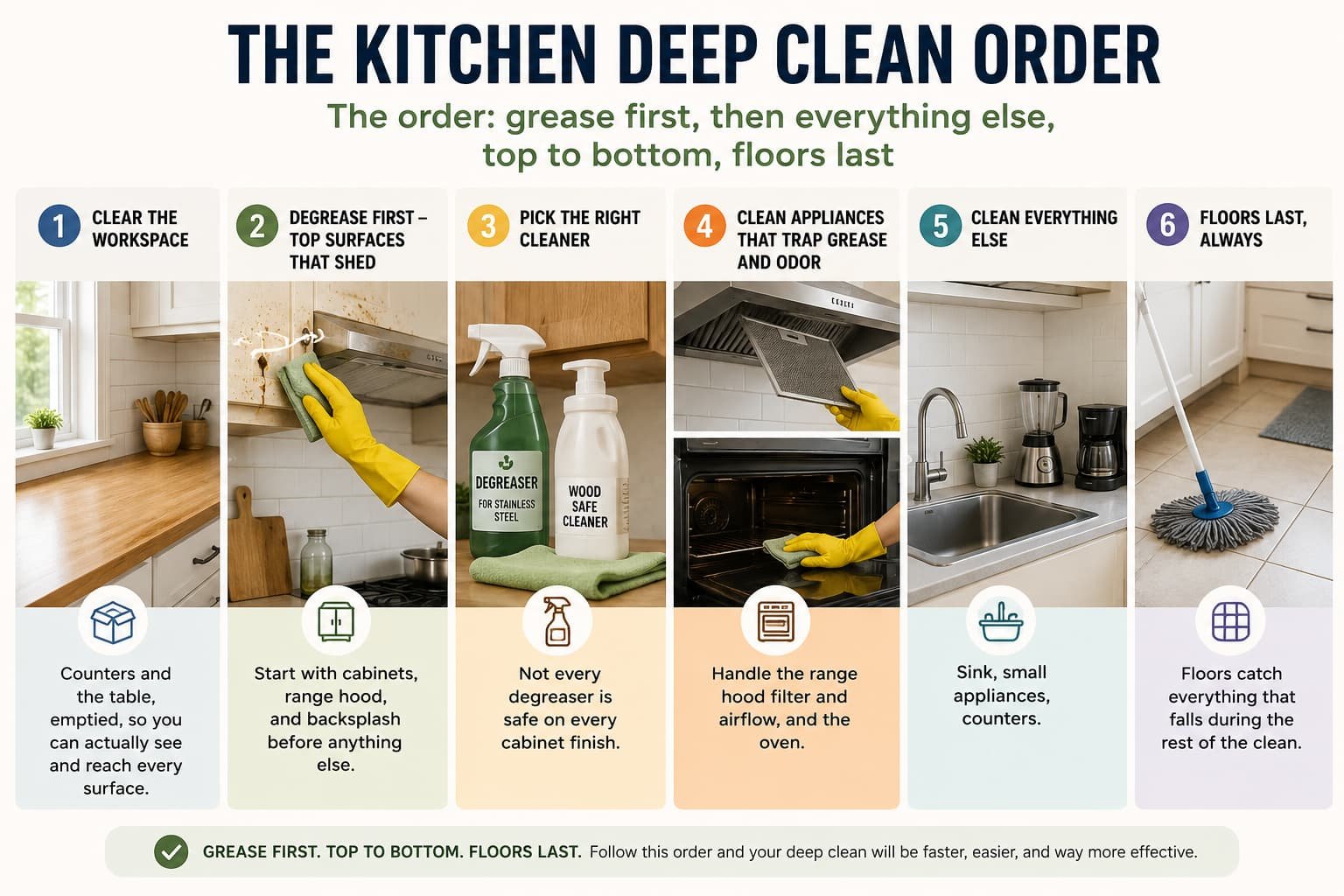
This is the whole method, and it’s short on purpose:
- Clear the workspace. Counters and the table, emptied, so you can actually see and reach every surface.
- Degrease the surfaces that shed onto everything else (cabinets, range hood, backsplash) before anything else.
- Pick the right cleaner for what you’re cleaning, since not every degreaser is safe on every cabinet finish.
- Handle the appliances that trap grease and odor, meaning the range hood’s filter and airflow, and the oven.
- Clean everything else: sink, small appliances, counters.
- Floors last, always, since they catch everything that falls during the rest of the clean.
Step 1: Clear and declutter the workspace
Empty the sink, clear the counters and the table, and pull anything expired or unused out of the way before you touch a single cleaner. This step is free and it is the one most people skip, which is exactly why the “quick wipe” never feels like it’s enough. You cannot properly degrease a cabinet front with a stand mixer and three days of mail sitting in front of it.
Step 2: Degrease first, because it sheds onto everything else
This is the step that makes the rest of the clean actually work. Three zones hold most of a kitchen’s airborne grease:
- Cabinets around the stove. If the fronts feel tacky rather than just dusty, that’s grease, not grime, and it needs the specific method for sticky cabinet grease rather than a general all-purpose spray.
- The range hood, inside and out. The filter traps the worst of it; cleaning a greasy range hood filter is its own short job and it directly affects how well the hood pulls smoke and odor out of the room.
- The backsplash, especially directly behind the burners. Grease settles into grout lines here in a way that plain wiping won’t lift; cleaning grease off a backsplash without damaging the grout covers the grout-first sequence.
Do these three before you touch the counters or the floor. Everything downstream goes faster once the source of the mess is handled.
Step 3: Pick your degreaser, and know your cabinet finish first
Not every degreaser is safe on every surface. Vinegar can dull a painted finish, and too much water on a laminate seam can cause swelling over time. Before you reach for whatever is under the sink, it’s worth a two-minute check: which cleaner is actually safe on your cabinet finish covers wood, laminate, painted and thermofoil cabinets specifically, and how the common degreasers compare, meaning dish soap, vinegar, baking soda paste and commercial cleaners, walks through what each one is actually good for.
Step 4: The appliances that trap grease and odor
Two appliances hold onto grease and smoke in ways a countertop wipe-down never reaches.
The range hood does the actual job of pulling grease-laden air out of the kitchen, so it deserves more than a glance. If yours runs but the kitchen still fills with smoke while you cook, that’s worth diagnosing properly rather than assuming a dirty filter is the whole story; why a range hood stops pulling smoke out walks through the checks in order, cheapest first.
The oven holds baked-on grease and food residue that a countertop clean never touches, and not everyone wants to run the self-clean cycle. Cleaning an oven without the self-clean cycle is a full manual method that handles this without the heat and fumes of that cycle.
Step 5: Floors last, always
Once the grease sources are handled and the counters, sink and appliance exteriors are wiped down, sweep or vacuum the floor to pick up whatever fell during the rest of the clean, then mop. Doing the floor first, or in the middle, just means mopping up crumbs and grease residue that hasn’t landed yet.
What you actually need before you start
You don’t need a cart full of specialty products to do this properly. A realistic kit covers most of it: a couple of microfiber cloths, dish soap, baking soda, white vinegar, a soft-bristled brush or an old toothbrush, and a bucket. Anything abrasive (steel wool, scouring pads) should stay in the cabinet unless a specific step calls for it on a confirmed-safe surface, since the fastest way to turn a deep clean into a repair job is scratching a finish you didn’t need to touch that hard.
Set aside more time than you think you need. A kitchen that’s gone a few months without a real clean is not a thirty-minute job, and rushing the degreasing step is exactly how grease ends up smeared onto a counter you thought you’d already finished.
A weekly-vs-deep-clean split so this doesn’t pile up again
A full deep clean doesn’t need to be a recurring event if a few things happen on a shorter cycle. Wipe visible grease off the stove-adjacent cabinet fronts weekly rather than letting it build to “sticky.” Check the range hood filter monthly. Everything else on this list can wait for a proper deep clean every few months, or whenever the kitchen starts to feel like it’s slipping, rather than on a fixed schedule that ignores how much you actually cook.
FAQ
What is the correct order to deep clean a kitchen?
Clear the workspace first, then degrease the surfaces that shed onto everything else (cabinets near the stove, the range hood, the backsplash), then clean everything else, and do the floor last. Cleaning in a different order means you re-clean surfaces that pick up grease dust from steps done afterward.
Why does my kitchen still feel dirty after I clean it?
Usually because the order was backward. If counters or floors were cleaned before the grease sources nearby (cabinets, range hood, backsplash), airborne grease from those surfaces settles right back onto what you just finished.
How often should a kitchen actually get a full deep clean?
There’s no fixed universal number, since it depends on how much cooking happens in it. A practical approach is a short weekly wipe-down of grease-prone surfaces, a monthly range hood filter check, and a fuller deep clean whenever buildup is visible or the kitchen stops feeling clean between regular cleanings.
Do I need special products for a kitchen deep clean?
Not necessarily. Dish soap and warm water handle most routine grease. Where it helps to know more, comparing degreasers and checking your cabinet finish first will tell you whether a stronger product is worth it for your specific surfaces.
How long does a full kitchen deep clean actually take?
There’s no universal figure, since it depends heavily on how long it’s been since the last one and how much cooking the kitchen sees. A kitchen that’s kept up with weekly wipe-downs will take far less time than one that’s gone several months, which is the honest reason a fixed time estimate isn’t useful here.
Should I clean the inside of cabinets during a deep clean, or just the fronts?
The fronts are the priority for a grease-focused deep clean, since that’s where airborne cooking grease actually lands. The insides are worth a look periodically for crumbs, spills or expired items, but they don’t carry the same grease buildup and don’t need to be part of every cleaning pass.