A range hood that runs but doesn’t actually clear smoke usually comes down to one of three things, in order of how common and how easy to check they are: a clogged filter, a blocked duct or a stuck exterior damper, or, least commonly, a failing motor. Work through them in that order rather than assuming the worst first. Anything past the filter and duct check, meaning the motor itself or wiring, is where this stops being a homeowner job.
This piece is part of the full kitchen cleaning order on House Tweaks. If you already know your filter is clean and want to check duct type, ducted vs recirculating range hoods explains how to tell which one you have.
The quick airflow test
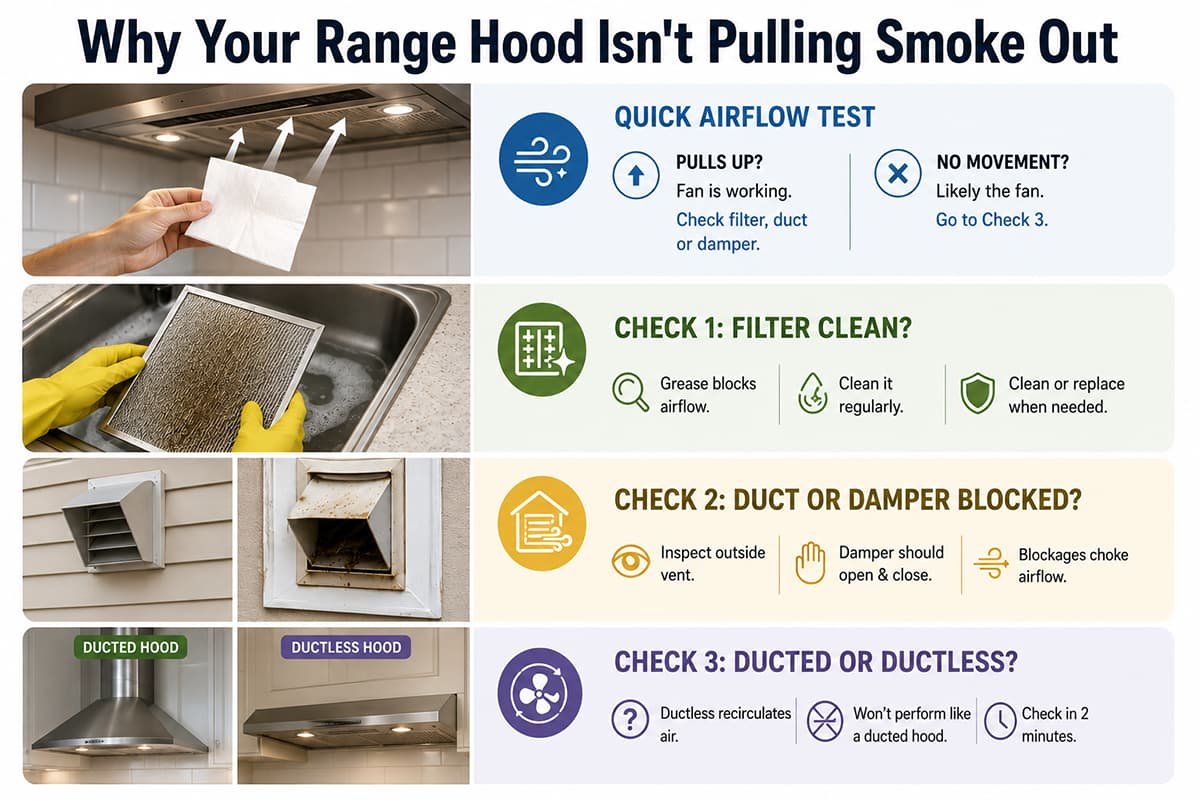
Before checking anything else, confirm the fan is actually pulling air. Hold a tissue or a small sheet of paper near the hood’s intake while it’s running. If it draws up and holds against the intake, the fan is moving air, and the problem is downstream (filter, duct or damper). If the paper doesn’t move at all, the issue is more likely the fan itself, which points toward Check 3 below.
Check 1: is the filter actually clean?
A grease-clogged filter is the single most common reason a range hood loses suction, because clogged mesh or baffles physically block airflow before it can be pulled through. If you haven’t cleaned yours recently, start there: how to clean a greasy range hood filter covers the soak-and-scrub method for washable filters, and when a filter should be replaced instead of cleaned.
Check 2: is the duct or exterior damper blocked?
If the filter is clean and airflow is still weak, the next most common cause is somewhere in the ductwork itself: a kink, a buildup of grease inside the duct, or a stuck exterior damper (the flap at the outside vent cap that’s supposed to open when the fan runs and close when it’s off). A damper that’s stuck shut from grease buildup or debris will choke airflow even with a perfectly clean filter and a healthy motor. This is a visual check from outside your house at the exterior vent; anything beyond confirming it opens and closes freely is worth a professional look.
Check 3: is this even a ducted hood?
If you’ve checked the filter and the duct path looks clear but performance still feels weak, it’s worth confirming what kind of hood you actually have. A ductless (recirculating) hood filters air back into the room instead of exhausting it outside, and it will never perform like a ducted hood no matter how clean the filter is, since it’s not designed to remove air from the kitchen at all. How to tell if your hood is ducted or ductless takes about two minutes to check.
What not to do while you’re checking
A few habits turn a straightforward diagnostic into a hazard. Don’t remove any cover panel beyond the filter itself to “take a look” at the motor, don’t spray any liquid cleaner directly into the fan housing or electrical area, and don’t attempt to bypass a switch or control board that isn’t responding. All three cross from cleaning and checking into repair territory, which is where a licensed technician takes over.
When it’s the motor or wiring: stop here
If the airflow test shows little to no suction, the filter is clean, and the duct path is clear, the remaining causes are the fan motor or the electrical connection, and neither is a job to open up yourself. Range hood motors and their wiring sit close to the same electrical circuit as the rest of the kitchen, and diagnosing or replacing a motor is a licensed appliance technician’s job. Don’t open the motor housing to investigate; call a technician and describe what you’ve already checked, since it will save them time and likely save you money on the service call.
FAQ
Why does my range hood run but not pull any smoke out?
The most common causes, in order, are a grease-clogged filter, a blocked duct or stuck exterior damper, or, less commonly, a weak or failing motor. Check the filter first since it’s the easiest and most frequent cause.
How do I know if my range hood fan is actually working?
Hold a tissue or a small piece of paper near the intake while the fan runs. If it draws up against the hood, air is moving. If it doesn’t move at all, the fan itself may not be pulling air.
Can I fix a range hood motor myself?
No. The motor and its wiring are not a homeowner repair. If filter and duct checks don’t resolve weak airflow, the next step is a licensed appliance technician, not opening the housing yourself.
Does a clogged filter really make that much difference?
Yes. A clogged filter physically restricts the airflow the fan is trying to pull through, so even a strong motor can’t move much air past a blocked mesh or baffle. It’s the first and most common thing to check.
My range hood makes noise but doesn’t seem to pull air. What does that mean?
A motor that runs (making noise) but produces little airflow points toward a blockage somewhere in the path, most likely the filter or the duct, rather than the motor itself having failed outright. Work through the filter and duct checks before assuming the motor is the problem.
Is it safe to keep using a range hood that isn’t venting properly?
The hood itself running with weak airflow isn’t typically a safety hazard on its own, but it does mean smoke, grease particles and cooking byproducts are staying in the kitchen air rather than being removed, so it’s worth fixing rather than ignoring, especially for gas ranges where ventilation also matters for combustion byproducts.
How long does it usually take to fix weak range hood airflow?
A dirty filter clean takes under an hour including soak time and solves the problem immediately for most kitchens. A blocked duct or stuck damper check is quick to inspect but may take longer to resolve depending on what’s actually blocking it. A motor or wiring issue is on a technician’s schedule, not yours, once you’ve handed it off.
Should I check the range hood’s controls or settings before assuming there’s a mechanical problem?
It’s worth a quick look. Some hoods have multiple fan speeds, and a unit left on its lowest setting can feel like it’s barely working even when everything is functioning correctly. Confirm it’s actually running on its highest speed before moving on to the filter, duct and motor checks above.
Is a weak range hood more noticeable in winter or summer?
Kitchens tend to be closed up tighter in winter, with windows shut and less natural air movement, which can make a range hood’s actual pulling power more noticeable since there’s less passive ventilation helping it along. A hood that seems fine in summer with a window cracked open may reveal a real airflow problem once the house is sealed up for colder weather.