If your washer is sitting full of water, unplug it at the wall and turn off both water supply taps before you touch anything else. You are standing next to a mains-powered appliance that is holding water, and that is the whole reason this order matters. Once the power and the water are off, two checks belong to you: the drain hose and the drain pump filter. Everything inside the cabinet, including the pump wiring, the door interlock and the control board, belongs to a qualified appliance technician. This article tells you where that line falls and why.
Most guides on this problem start with a list of causes. That is useful information in the wrong order, because the reader who searches this phrase is usually looking at the machine right now, sometimes with water on the floor. So the sequence comes first.
Power off, water off, before anything else
Pull the plug from the socket. Not the power button on the fascia, and not the cycle-cancel option. A button interrupts a control circuit. Pulling the plug interrupts the supply.
If the socket is behind the machine and reaching it means leaning across a wet floor, switch off the circuit at your consumer unit or breaker panel instead, then confirm the machine is dead by pressing a button on the front. A blank panel means the supply is off.
Now close both supply taps, the hot and the cold, on the wall behind the machine. They are usually a quarter-turn lever or a small round tap on the ends of the inlet hoses. Doing this stops the machine refilling if a valve or a control has failed, which is exactly the failure that would otherwise put more water on your floor while you are working.
If there is water on the floor already, treat the area as live until the plug is out. Dry the floor before you kneel on it.
Do not open the rear panel, the top panel or any wiring cover on the machine. The supply cable, the motor connections and the control board sit behind those, and that work belongs to a licensed electrician or a qualified appliance technician depending on which part has failed.
Not draining and not spinning are one problem, in that order
This is the part almost every article skips, and it decides how far you can usefully go.
A washer will not spin while it still has water in the drum. The machine drains first, then spins, and a spin against a full tub would throw an enormous unbalanced weight around inside the cabinet. So if the drum is full, the spin fault is a symptom, not a second fault. Fix the drainage and the spin usually comes back on its own.
The reverse case is different. If the machine drains fine but will not spin, the water has left, the cycle has completed, and the clothes are simply wet and heavy. That points at load balance, the cycle you chose, or the door or lid switch, and it is a separate diagnosis.
Work out which of the two you have before you do anything else. It is the difference between a blocked hose and a mechanical problem.
The causes that are not faults at all
Three of the most common versions of this problem are the machine behaving exactly as designed.
Too much detergent. Whirlpool's own troubleshooting guidance for a washer that will not drain or spin, read 2026-09-07, states that "high amounts of detergent can create too many suds" and that this can stop the machine draining properly. Its instruction is to measure detergent and follow the manufacturer's directions. High-efficiency machines use very little water, so the dose that looked right in an older washer is a genuine overdose in this one. If your water is soft, you need less again, and the signs of hard water in a house covers how to tell which you have without guessing.
The cycle you selected. Whirlpool notes that gentle, delicate and handwash cycles "use slow spins" and deliberately leave more water in the load. Clothes that come out heavy after a delicate cycle are not evidence of a fault.
An unbalanced or overloaded drum. A washer that detects a load it cannot spin safely will slow down or stop rather than damage itself. Whirlpool's advice is to redistribute the items or reduce the load size. A single wet duvet bunched on one side of the drum does this reliably.
Rule those three out before you decide the machine is broken, because none of the three costs anything to correct.
The drain hose and the standpipe behind the machine
With the power out and the taps closed, pull the machine forward far enough to see the back of it. The corrugated hose leaving the machine is the drain hose, and two things about it matter.
The first is obstruction. A hose that got pinched or sharply kinked when the machine was last pushed back against the wall will not pass water. Straighten it and look along its length.
The second is height, and this is where a number is worth having. Whirlpool publishes a specific range for the drainpipe, also called the standpipe, that the hose empties into: "96 inches (244 cm) maximum and 30 inches (76.2 cm) minimum." Too low and the machine can siphon itself empty as it fills. Too high and the pump cannot lift the water. If your machine has been moved, or the plumbing was changed, that measurement is worth taking.
Where the hose enters a standpipe or a sink trap, lint and detergent scale collect at the end of it. That is homeowner territory. Cutting into, re-routing or re-plumbing the household waste pipe is a licensed plumber's work, and it is a different job from clearing the end of your own hose.
The drain pump filter, and the water behind it
Most front-loading washers have a small access panel at the bottom front of the cabinet. Behind it sits the drain pump filter, sometimes called a coin trap, and it is where buttons, coins, hair grips and lint end up. A loaded filter is one of the most common reasons a machine will not drain.
LG's support guidance for its own washers, read 2026-09-07, recommends cleaning the drain pump filter "on a monthly basis," and specifically flags doing it when drainage slows or an OE error code appears. Other makers publish their own intervals. Use yours, not a number from a blog.
Two cautions before you open one.
There is water behind it, and there may be a lot of it. LG's procedure is to pull out the small drain hose next to the filter, remove its plug, and let the water run into a shallow pan first, warning that pulling the hose too far out kinks it and stops it draining. Do that before you unscrew the filter itself, or you will empty the whole drum onto your floor through the filter opening.
The water can be hot. If the machine stopped mid-cycle on a warm or hot wash, what comes out is the temperature of that wash. Let it stand until it is cool before you start, and keep your face away from the opening.
Cleaning a filter is a maintenance job, not a repair, and the pattern is the same across appliances. If you have done a dishwasher filter before, this is the same discipline: lift the debris out, rinse the mesh, do not force anything, and put it back correctly. Reseat the filter fully and turn it until it stops, because a filter left loose leaks.
The door that will not open
On a front-loader holding water, the door will stay locked. That is the interlock doing its job, and it is not a fault to fix.
Draining the machine through the filter drain hose is usually what releases it. Some machines also have a manual release tab behind the same access panel, and your manual will say whether yours does.
What not to do: do not force the door, do not lever the glass, and do not attempt to defeat the interlock. It exists to stop a drum of hot water opening onto whoever is standing there. If the machine is empty and cool and the door still will not release, that is the lock assembly, and it is wired into the supply. That is a technician's job.
Where your part of this ends
Each boundary below is real and each one has a different trade behind it.
| What has failed | Whose job it is |
|---|---|
| Drain hose kinked, blocked or badly routed | Yours |
| Drain pump filter loaded with debris | Yours |
| Detergent dose, cycle selection, load balance | Yours |
| Household waste pipe past your hose connection | Licensed plumber |
| Drain pump, its wiring or the motor | Qualified appliance technician |
| Door interlock or lid switch | Qualified appliance technician |
| Control board, or the machine's power supply | Qualified appliance technician, or a licensed electrician for the supply |
The pump runs but the water does not move: the path is blocked, and the checks above cover it. You hear nothing at all when the machine should be pumping: stop there. A drain pump is a sealed assembly wired into the supply, and diagnosing it means putting hands and meters inside a cabinet that holds mains voltage and water in the same space.
Two things to check before you pay anyone
Your warranty. Manufacturer warranties commonly exclude damage caused by service the manufacturer did not authorize, and the terms differ by brand, by country and by model. Read your own warranty document before you open anything beyond the filter and the hose. If the machine is still covered, calling the maker's service line is not the slow option, it is the cheap one.
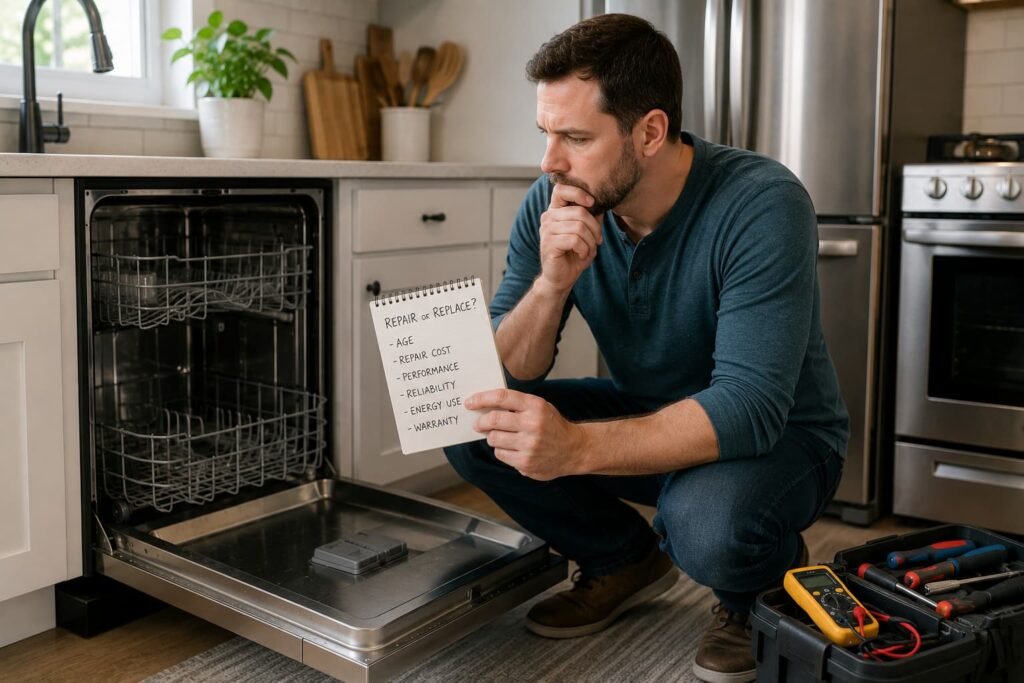
The machine's age against the repair. A drain pump on a three-year-old machine is a straightforward decision. The same repair on a machine well into its second decade is a different question, and it is worth answering deliberately rather than on the phone with a technician standing in your kitchen. Our guide to whether to repair or replace an appliance sets out how to weigh it.
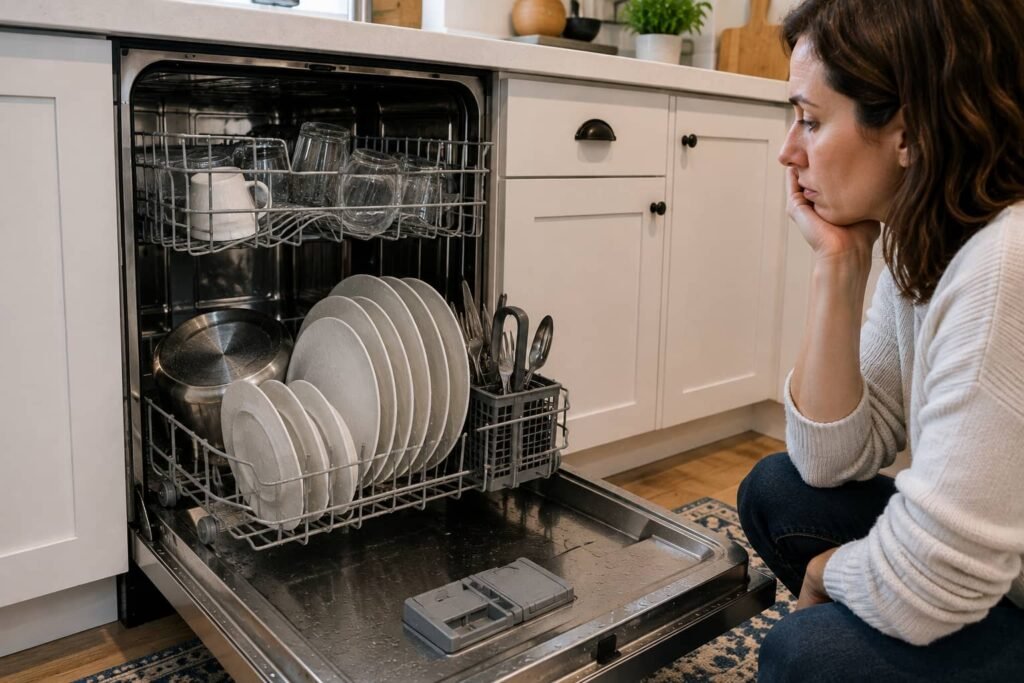
If this pattern feels familiar, it is: standing water, a blocked path and a hard stop at the pump is the same shape of problem as a dishwasher that will not drain, and the reasoning transfers almost intact.
FAQ
Why won't my washer spin when it drains fine? Because a spin fault with an empty drum is a different problem from a drain fault. Check load balance first, then the cycle you selected: Whirlpool states that gentle, delicate and handwash cycles use slow spins and leave more water in the load by design. If the drum is empty, cool and evenly loaded and it still will not spin, the door or lid switch and the drive components are next, and those are a technician's job.
Can I use a drain cleaner to unblock my washing machine? No. A washing machine drain path runs through a pump, flexible hoses and rubber seals, and caustic drain openers are formulated for household waste pipes, not for appliance components. If the blockage is in the machine, it is in the filter or the hose, and both are reachable by hand.
How often should I clean the drain pump filter? Follow your own manufacturer. LG recommends monthly for its washers and flags doing it whenever drainage slows. If you wash pet bedding, heavily soiled work clothes, or anything that sheds, expect to do it more often than the manual suggests.
Is it safe to bail the water out myself? Yes, once the machine is unplugged, the supply taps are closed and the water has cooled. Use a jug and towels rather than reaching into the drum, and drain the machine through the filter access hose rather than tipping it.
The machine stopped mid-cycle and the door is locked. What now? That is the interlock working correctly, not a failure. Draining the water through the filter access hose normally releases it, and some machines have a manual release tab behind the same panel. Never force the door or bypass the lock.
I don't sell washing machines, spare parts or repair callouts, which is why this page can tell you that three of the most common causes cost nothing to fix and that the fourth is not yours to touch. More about how this site works is on the page about why I started House Tweaks.